
Day-to-Day Comfort... Year-to-Year Confidence
For fast, reliable solutions...
Call (574) 674-0841

Special Offers

  • NO CAP SAVINGS on Geothermal equipment and installation --  SAVE UP TO 30% OF THE COST with Federal Tax Credits
  • REPLACEMENT REBATES FROM THE STATE OF INDIANA on qualifying furnace, boiler, air conditioner, air source heat pump or geothermal replacement systems
  • SAVE UP TO $1500 with Federal Tax Credits on  the installation of qualifying furnaces, heat pumps and air conditioners
  • NIPSCO REBATES available on qualifying furnace, boiler and water heater equipment in Indiana

Air Conditioning Equipment & Installation - South Bend Indiana, Mishawaka, Granger and Elkhart, licensed in southern Michigan and all of Michiana

Air conditioning --- temperature and humidity levels – can mean the difference between loving living here in the Midwest…or not. And how well (or how poorly) your air conditioning equipment performs depends on how well-matched it is to your specific situation.
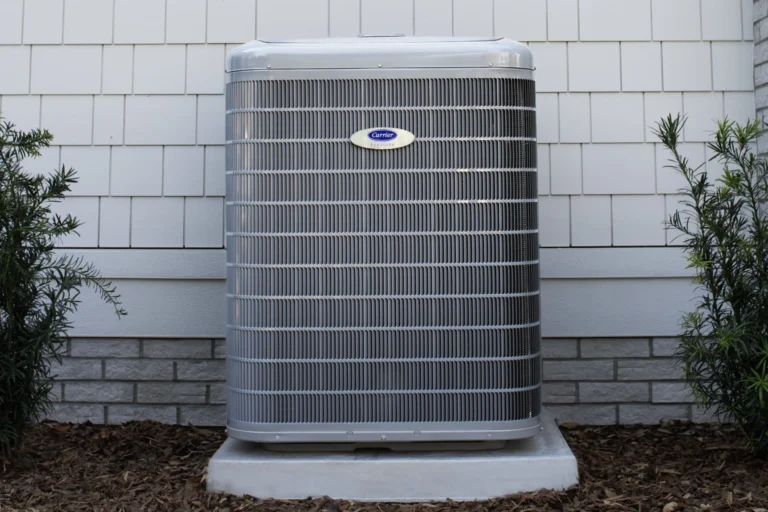
Heat pumps and most central air conditioners are called "split systems" because there is an outdoor unit (called a condenser) and an indoor unit (an evaporator coil). The job of the heat pump or air conditioner is to transport heat from one of these units to the other. In the summer, for example, the system extracts heat from indoor air and transfers it outside, leaving cooled indoor air to be re-circulated through your ducts by a fan.

Basically, here's how it works:
The compressor in your outdoor unit will change the gaseous refrigerant into a high temperature, high-pressure gas. As that gas flows through the outdoor coil,
it loses heat. That makes the refrigerant condense into a high temperature, high pressure liquid that flows through copper tubing into the evaporator coil located in your fan coil unit or attached to your furnace. At that point, the liquid refrigerant is allowed to expand, turning the liquid refrigerant into a low temperature, low pressure gas. The gas then absorbs heat from the air circulating in your home's ductwork, leaving it full of cooler air to be distributed throughout the house. Meanwhile, the low temperature, low pressure refrigerant gas returns to the compressor to begin the cycle all over again.

While your air conditioner or heat pump cools the air, it also dehumidifies it. That's because warm air passing over the indoor evaporator coil cannot hold as much moisture as it carried at a higher temperature, before it was cooled. The extra moisture condenses on the outside of the coils and is carried away through a drain. The process is similar to what happens on a hot, humid day, when condensed moisture beads up on the outside of a glass of cold lemonade.

The same process works in reverse in a heat pump during the winter. The heat pump takes heat out of the outside air - or out of the ground, if you have a geothermal heat pump --- moves that heat inside, where it is transferred from the evaporator coil to the air circulating through your home. The heat pump moves heat from outside to warm your home, even on a cold day. That's because "cold" is a relative term. Air as cold as 30 degrees still contains a great deal of heat - the temperature at which air no longer carries any heat is well below -200 degrees Fahrenheit. A heat pump's heat exchanger can squeeze heat out of cold air, and then transfer that heat into your home with the help of a fan which circulates the warm air through your ducts.

Heat pumps are often installed with back-up electric resistance heat or a furnace to handle heating requirements when more heat is needed than the heat pump can efficiently extract from the air.

When to Replace your Air Conditioner and/or Furnace

To repair or replace, that is the question that likely comes to mind whenever your heating or cooling system stops working like it should. Although repairing may be the most affordable solution now, it might not be the best choice over the long run.

Factors to consider include:

Fifty Percent Rule
When the cost of repairs approaches 50% of the value of your heating or cooling system, it’s generally time to replace the system.

Other Rules of Thumb
Even if needed repair costs aren’t quite as daunting as 50%, you might want to replace your system if it’s more than 12 years old or you’ve had a history of problems with it. Also, it might be worthwhile to take advantage of one of several opportunities:
• Convenience – When you purchase a new system, you can avoid the hassle of unexpected repairs down the line, and you don’t have to sit around uncomfortable while waiting for parts.
• Lower utility bills – A high-efficiency home comfort system from Lennox can save you hundreds of dollars each year in energy costs, compared to an older system.
• Energy tax credits – You can recover up to 30% of the cost of select high-efficiency systems in the form of tax credits.
• Friendlier refrigerant – Due to growing environmental concerns, the U.S. federal government has mandated that all HVAC manufacturers phase R-22 refrigerant-based equipment out of production. In response, our equipment manufacturers now only produce cooling systems with R-410A, a U.S. EPA-approved, chlorine-free refrigerant.
• Enhanced comfort – Advanced technologies that improve energy efficiency also enhance your comfort, so you can enjoy more even temperatures, better humidity control and a constant flow of conditioned air.
• Improved air quality – Better humidity control means a reduced potential for mold and mildew growth.